Basic 4 · English Language
Songs, Letter Patterns, Nouns, Joined Writing and Commas
In this topic you will sing songs with stress and rhythm, match sounds to letter patterns, use nouns, practise joined handwriting and use commas.
By the end of these notes you should be able to:
- Sing songs with appropriate stress, rhythm and actions
- Match sounds to their letter patterns
- Identify and use nouns
- Write neatly with joined letters
- Use commas correctly
What you already know
- English Basic 3
Copy everything that has a blue line on its left into your notebook. The other parts are for reading.
Lesson 1
- Strand
- Oral Language
- Sub-strand
- Songs
- Indicator
- B4.1.1.1.1 – Sing songs with appropriate stress rhythm and actions
Introduction
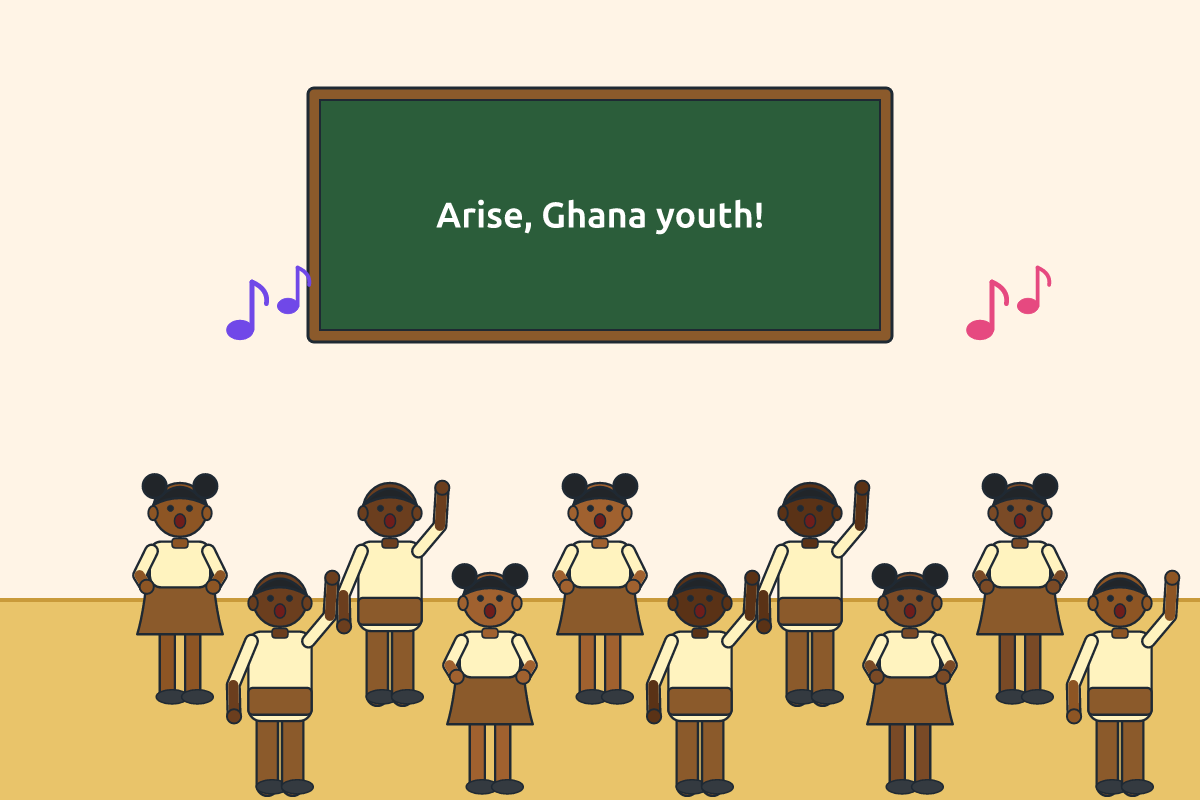
When we sing, some words are said more strongly than others. This is called stress. Stress and rhythm make songs lively.
Singing with Stress and Rhythm
Example: "WE are the CHILDren of GHAna, PROUD and STRONG and FREE."
Tips
- clap on the stressed (strong) syllables
- keep a steady rhythm
- add actions that match the words
New words
- stress
- Saying a syllable more strongly.
- rhythm
- The pattern of strong and weak beats.
- syllable
- A part of a word with one vowel sound.
Summary
- Stress means saying some syllables more strongly.
- Rhythm and actions make songs lively.
Exercises
Answer in your exercise book first, then check your answers.
1. Saying a syllable more strongly is…
- A. Stress
- B. Rhythm
- C. Rhyme
- D. Pause
Show answer
Answer: StressThat is stress.2. Actions can make songs lively.
- A. True
- B. False
Show answer
Answer: TrueThey add meaning and fun.3. The pattern of strong and weak beats is ______.
Show answer
Answer: rhythmThat is rhythm.4. Clap the stressed syllables in "Ghana, my happy home".
Show answer
Answer: GHA-na, my HAP-py HOMEStrong syllables are clapped.
Lesson 2
- Strand
- Reading
- Sub-strand
- Phonics
- Indicator
- B4.2.2.1.1 – Match sounds to their corresponding letter patterns
Introduction
Some sounds can be spelt with different letter patterns.
Sounds and Letter Patterns
| Sound | Patterns | Words |
|---|---|---|
| long "a" | a-e, ai, ay, eigh | cake, rain, day, eight |
| long "o" | o-e, oa, ow | bone, goat, grow |
| "er" | er, ir, ur | her, bird, turn |
| "f" | f, ph, gh | fan, phone, laugh |
New words
- sound
- What we hear.
- letter pattern
- Letters that represent a sound.
- vowel
- a, e, i, o or u.
Summary
- One sound can have several spellings.
- Learning patterns helps spelling and reading.
Exercises
Answer in your exercise book first, then check your answers.
1. Which word has the "ir" pattern?
- A. bird
- B. bed
- C. bad
- D. bud
Show answer
Answer: birdb-ir-d.2. "eigh" can make the long "a" sound.
- A. True
- B. False
Show answer
Answer: TrueAs in "eight".3. "gh" in "laugh" sounds like ______.
Show answer
Answer: fgh makes f here.4. Write two words with the long "o" sound.
Show answer
Answer: E.g. goat, grow, bone.o-e, oa, ow.
Lesson 3
- Strand
- Grammar
- Sub-strand
- Nouns
- Indicator
- B4.3.1.1.1 – Identify and use nouns to identify people animals events and objects
Introduction
Nouns are naming words. Every person, place, animal and thing has a name.
Nouns
Noun: A word that names a person, animal, place, thing or event.
| Type | Examples |
|---|---|
| person | teacher, Esi, farmer |
| animal | goat, eagle |
| place | Kumasi, market |
| thing | book, chair |
| event | festival, wedding |
New words
- noun
- A naming word.
- event
- Something that happens.
- name
- What something is called.
Summary
- Nouns name people, animals, places, things and events.
- Every sentence usually has at least one noun.
Exercises
Answer in your exercise book first, then check your answers.
1. Which is a noun?
- A. Market
- B. Run
- C. Quickly
- D. Blue
Show answer
Answer: MarketIt names a place.2. "Festival" is a noun.
- A. True
- B. False
Show answer
Answer: TrueIt names an event.3. The ______ teaches us English. (teacher / teach)
Show answer
Answer: teacherTeacher is a noun.4. Find the nouns: "The farmer sold yams at the market."
Show answer
Answer: farmer, yams, marketThey name things.
Lesson 4
- Strand
- Composition Writing
- Sub-strand
- Penmanship
- Indicator
- B4.4.2.1.1 – Write clearly using joined letters of consistent size
Introduction
Joined handwriting is quicker and neater once you learn it.
Joined Handwriting
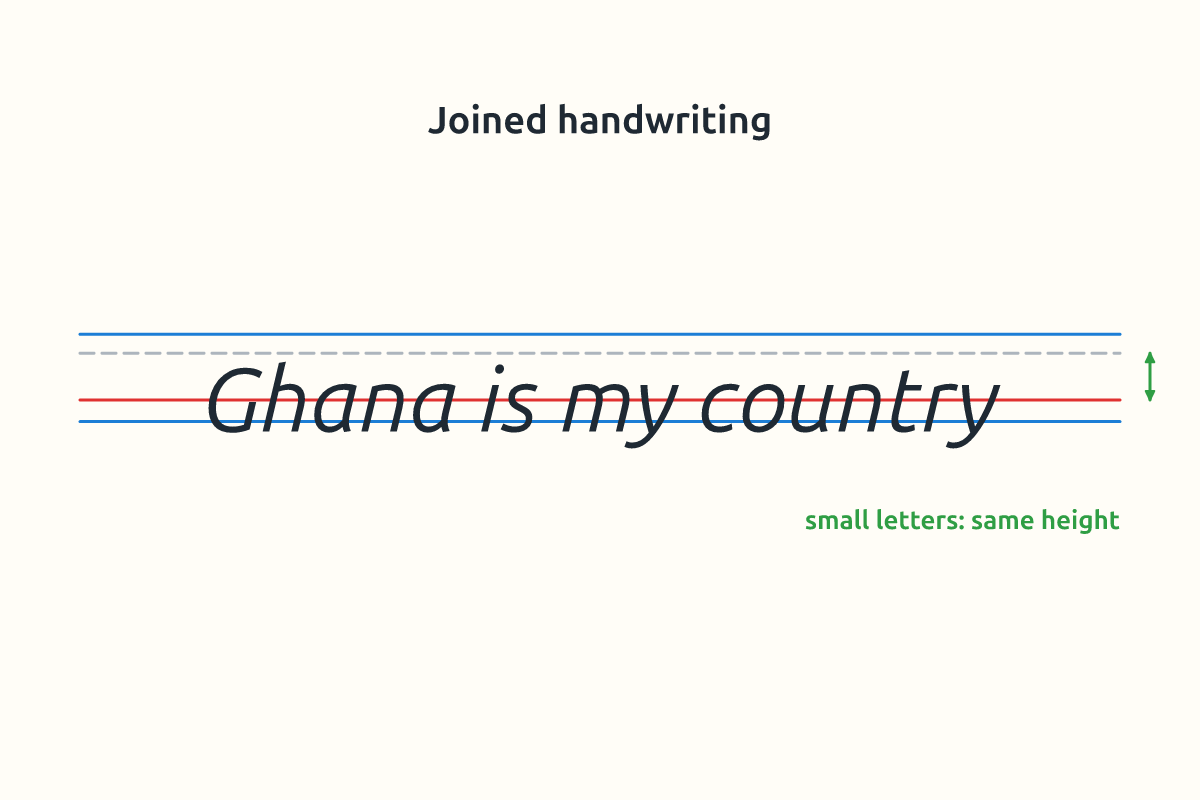
- Join letters with smooth strokes.
- Keep all small letters the same height.
- Keep tall letters and tail letters the right size.
- Leave equal spaces between words.
New words
- joined
- Connected together.
- consistent
- The same each time.
- stroke
- A line made with a pen.
Summary
- Joined writing connects letters with smooth strokes.
- Keep letter sizes consistent.
Exercises
Answer in your exercise book first, then check your answers.
1. Joined handwriting connects…
- A. Letters
- B. Pages
- C. Books
- D. Desks
Show answer
Answer: LettersLetters are joined.2. Small letters should be the same height.
- A. True
- B. False
Show answer
Answer: TrueThat is consistency.3. The same each time means ______.
Show answer
Answer: consistentThat is consistent.4. Write your name in joined handwriting.
Show answer
Answer: Answers will differ.Joined letters.
Lesson 5
- Strand
- Writing Conventions/ Extensive Reading
- Sub-strand
- Using Punctuation, Building the Love and Culture of Reading
- Indicator
- B4.5.2.1.1 – Use the "comma" appropriately in sentence
Introduction
A comma (,) tells the reader to pause. Today you will use commas and read a short passage.
Using Commas
| Use | Example |
|---|---|
| in a list | We bought yam, fish, pepper and onions. |
| after introductory words | Yesterday, it rained heavily. |
| when addressing someone | Ama, please close the door. |
Reading passage: "On Saturday, Akwasi helped his mother at the market. They sold tomatoes, pepper and garden eggs. 'Akwasi, bring the basket,' his mother called. By evening, they had sold everything."
New words
- comma
- A mark that shows a short pause.
- list
- Items named one after another.
- introductory
- Coming at the beginning.
Summary
- Commas separate items in a list.
- Commas follow introductory words and names of people addressed.
Exercises
Answer in your exercise book first, then check your answers.
1. Which sentence uses commas correctly in a list?
- A. I like rice, beans and plantain.
- B. I like rice beans, and, plantain.
- C. I, like rice beans and plantain.
- D. I like, rice beans plantain.
Show answer
Answer: I like rice, beans and plantain.Commas separate items.2. A comma comes after "Yesterday" at the start of a sentence.
- A. True
- B. False
Show answer
Answer: TrueIt is an introductory word.3. What did they sell? Tomatoes, pepper and ______.
Show answer
Answer: garden eggsFrom the passage.4. Add commas: "Kofi please bring my bag pen and book."
Show answer
Answer: Kofi, please bring my bag, pen and book.Address and list.
Homework
- Write five sentences using commas in different ways.