Basic 4 · Creative Arts · Appreciating and Appraising
Guidelines for Appraising Performances
In this topic you will develop guidelines for appraising and appreciating performances.
By the end of these notes you should be able to:
- Develop a set of appraisal criteria
- Use a rating scale
- Give balanced feedback on performances
What you already know
- Planning a performance
Copy everything that has a blue line on its left into your notebook. The other parts are for reading.
- Strand
- Performing Arts
- Sub-strand
- Appreciating and Appraising
- Indicator
- B4.2.4.6.1 – Develop guidelines for appraising and appreciating own and others' performing artworks
Introduction
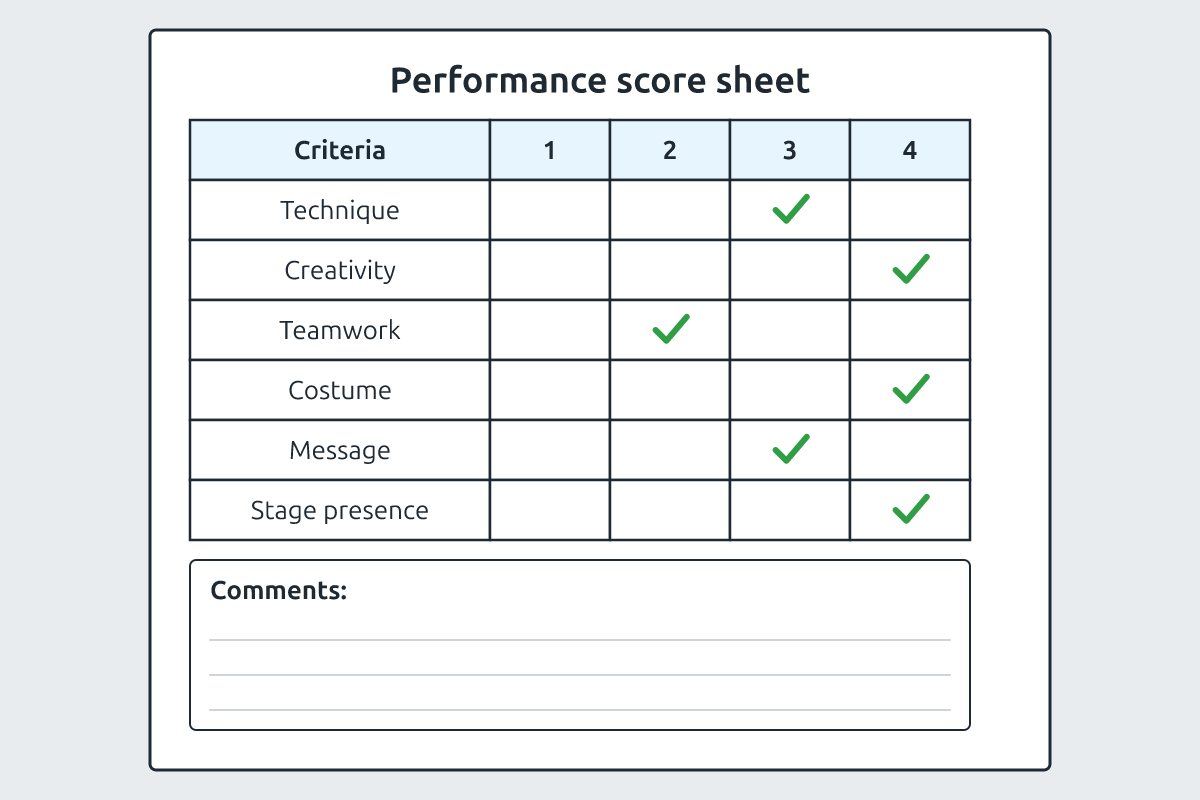
At a music competition, judges use criteria to give marks. Your class will create its own guidelines for judging performances fairly.
1. Appraisal Criteria
| Criterion | What to look for |
|---|---|
| technique | correct singing, drumming or dance steps |
| creativity | original ideas |
| teamwork | performers working together |
| costume and props | suitable and well made |
| message | clear meaning or story |
| stage presence | confidence and audience contact |
2. Rating Scale
| Score | Meaning |
|---|---|
| 4 | excellent |
| 3 | good |
| 2 | fair |
| 1 | needs improvement |
3. Balanced Feedback
Give one strength, one area to improve and one encouragement.
Example: "Your drumming was strong. The dancers should practise turning together. Well done!"
New words
- appraise
- To judge the quality of something.
- criterion
- A standard used for judging (plural: criteria).
- rating scale
- Numbers used to score quality.
- technique
- Skill in doing something.
- stage presence
- Confidence on stage.
- balanced
- Fair, including good points and improvements.
Summary
- Criteria help judge performances fairly.
- A rating scale gives scores from 1 to 4.
- Feedback should include strengths and improvements.
- Fair judging encourages performers.
Class activity: Judge Panel
- Use your score sheet to judge another group's performance.
- Add scores and write comments.
- Present your balanced feedback.
You need: Locally made drum, Gourd shaker, Kente cloth sample
Exercises
Answer in your exercise book first, then check your answers.
1. A standard used for judging is a…
- A. Criterion
- B. Costume
- C. Chorus
- D. Venue
Show answer
Answer: CriterionThat is a criterion.2. Confidence on stage is called…
- A. Stage presence
- B. Technique
- C. Rhythm
- D. Contrast
Show answer
Answer: Stage presenceThat is stage presence.3. On the rating scale, 4 means…
- A. Excellent
- B. Poor
- C. Fair
- D. Absent
Show answer
Answer: Excellent4 is the top score.4. Balanced feedback includes strengths and improvements.
- A. True
- B. False
Show answer
Answer: TrueIt is fair.5. Judges should give marks without criteria.
- A. True
- B. False
Show answer
Answer: FalseCriteria make judging fair.6. Skill in doing something is ______.
Show answer
Answer: techniqueThat is technique.7. Name four criteria for judging a performance.
Show answer
Answer: Any four: technique, creativity, teamwork, costume, message, stage presence.These are criteria.8. Why should feedback include an encouragement?
Show answer
Answer: It motivates performers to keep improving.Encouragement builds confidence.
Homework
- Judge a performance on TV using your criteria.