Basic 3 · Ghanaian Language · Reading
Reading Aloud with Expression and Understanding
In this topic you will read stories aloud with expression and retell them in your own words.
By the end of these notes you should be able to:
- Read with expression
- Use different voices for characters
- Retell a story in your own words
What you already know
- Reading short stories aloud
Copy everything that has a blue line on its left into your notebook. The other parts are for reading.
- Strand
- Extensive Reading
- Sub-strand
- Reading
- Indicator
- B3.6.2.1.1 – Read short stories aloud correctly with expression
Introduction
Good readers make stories come alive. They change their voices for different characters and show feelings.
1. Reading with Expression
| Tip | Example |
|---|---|
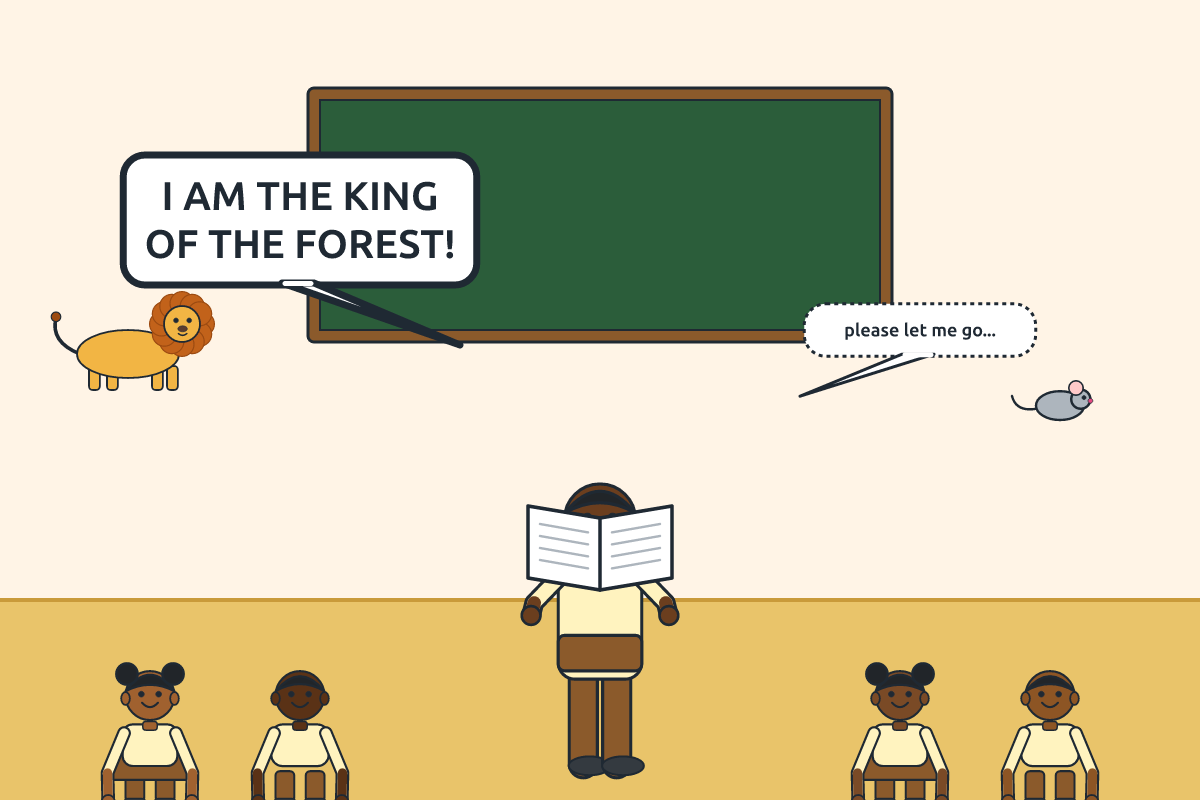
| change voices for characters | a deep voice for a lion, a squeaky voice for a mouse |
| show feelings | sound sad when a character is sad |
| read questions with a rising voice | "Where is my goat?" |
| read exclamations strongly | "Help!" |
2. A Story to Read
"'Help!' cried the little mouse. 'Please let me go!' The lion laughed in his deep voice. 'Why should I?' he asked. 'One day I may help you,' said the mouse. The lion let him go. Later, the mouse freed the lion from a hunter's net."
3. Retelling
In my own words: "A lion let a small mouse go. Later, the mouse saved the lion by chewing through a net."
New words
- expression
- Showing feeling with your voice.
- character
- A person or animal in a story.
- retell
- To tell again in your own words.
- exclamation
- A word or sentence said with strong feeling.
Summary
- Read with expression by changing voices and showing feelings.
- Questions rise; exclamations are strong.
- Retell stories in your own words.
Class activity: Story Theatre
- Read the story with different voices for each character.
- Retell it in your Ghanaian language.
- Act it out for the class.
You need: Ghanaian-language storybook, Locally made sentence cards, Pointer stick
Exercises
Answer in your exercise book first, then check your answers.
1. What voice suits a lion?
- A. Deep
- B. Squeaky
- C. Silent
- D. Whisper
Show answer
Answer: DeepLions have big voices.2. How should "Help!" be read?
- A. Strongly
- B. Softly
- C. Slowly
- D. Silently
Show answer
Answer: StronglyIt is an exclamation.3. Our voice rises at the end of a question.
- A. True
- B. False
Show answer
Answer: TrueThat shows asking.4. Good readers use the same flat voice for every character.
- A. True
- B. False
Show answer
Answer: FalseThey change voices.5. Showing feeling with your voice is ______.
Show answer
Answer: expressionThat is expression.6. Retell the lion and mouse story in one sentence.
Show answer
Answer: E.g. The lion let the mouse go, and later the mouse saved him.Use your own words.
Homework
- Read a storybook to a younger child using different voices.