Basic 2 · Mathematics · Patterns and Relationship
Patterns with Taking Away and Arrays
In this topic you will find patterns that get smaller and use arrays to show repeated adding.
By the end of these notes you should be able to:
- Find the rule in patterns that get smaller
- Make arrays of objects
- Use arrays to show repeated addition
What you already know
- Number patterns
Copy everything that has a blue line on its left into your notebook. The other parts are for reading.
- Strand
- Algebra
- Sub-strand
- Patterns and Relationship
- Indicator
- B2.2.1.1.2 – Identify create and describe the rule for simple number patterns involving repeated addition or subtraction skip counting and arrays of objects
Introduction
A seller has 50 mangoes. She sells 10 every hour: 50, 40, 30, 20. The pattern gets smaller by 10 each time.
1. Patterns That Get Smaller
| Pattern | Rule | Next |
|---|---|---|
| 50, 40, 30, 20 | take away 10 | 10 |
| 20, 18, 16, 14 | take away 2 | 12 |
| 100, 95, 90, 85 | take away 5 | 80 |
2. Arrays
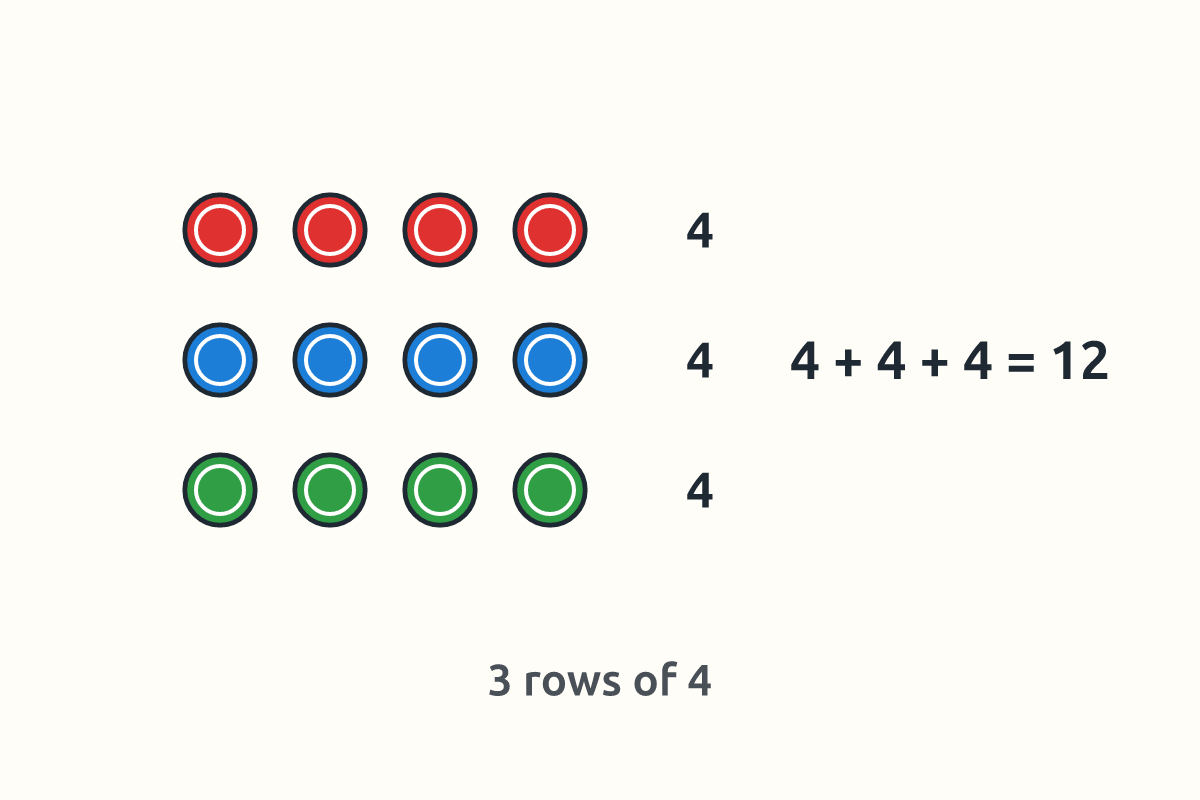
Array: Objects arranged in equal rows and columns.
3 rows of 4 bottle tops make 4 + 4 + 4 = 12.
Example
How many eggs are in 2 rows of 6?
- Each row has 6.
- 6 + 6 = 12
Answer: 12 eggs
Tip: An egg tray is a real array.
New words
- array
- Objects in equal rows and columns.
- row
- A line going across.
- column
- A line going down.
- repeated addition
- Adding the same number again and again.
Summary
- Some patterns get smaller by taking away the same number.
- An array has equal rows and columns.
- Arrays show repeated addition, like 4 + 4 + 4 = 12.
Class activity: Bottle Top Arrays
- Make arrays with bottle tops: 2 rows of 3, 3 rows of 5.
- Write the adding sentence for each.
- Count to check the total.
You need: Bottle tops, Locally made number cards, Exercise books
Exercises
Answer in your exercise book first, then check your answers.
1. What comes next? 30, 25, 20, ___
- A. 15
- B. 10
- C. 25
- D. 18
Show answer
Answer: 15Take away 5 each time.2. How many are in 4 rows of 3?
- A. 12
- B. 7
- C. 10
- D. 34
Show answer
Answer: 123 + 3 + 3 + 3 = 12.3. An array has equal rows.
- A. True
- B. False
Show answer
Answer: TrueEvery row has the same number.4. 2 rows of 5 makes 7.
- A. True
- B. False
Show answer
Answer: False5 + 5 = 10.5. 60, 50, 40, ______
Show answer
Answer: 30Take away 10.6. Draw an array for 5 + 5 + 5 and write the total.
Show answer
Answer: 3 rows of 5; total 15Three rows of five make 15.
Homework
- Find an array at home (egg tray, window panes, tiles). Write its adding sentence.