Basic 2 · English Language
Drama, Sight Words, Substitution Tables and Time Prepositions
In this topic you will listen to drama, read sight words, use substitution tables and use prepositions for days, dates and places.
By the end of these notes you should be able to:
- Listen and respond to a drama
- Use sight words in sentences
- Write sentences from substitution tables
- Use on, in and at for days, dates and places
What you already know
- Feelings and weather
Copy everything that has a blue line on its left into your notebook. The other parts are for reading.
Lesson 1
- Strand
- Oral Language
- Sub-strand
- Listening Comprehension
- Indicator
- B2.1.7.1.1 – Listen to and interact actively with drama
Introduction
A drama is a story acted out with dialogue. Listen carefully and respond.
Listening to a Drama
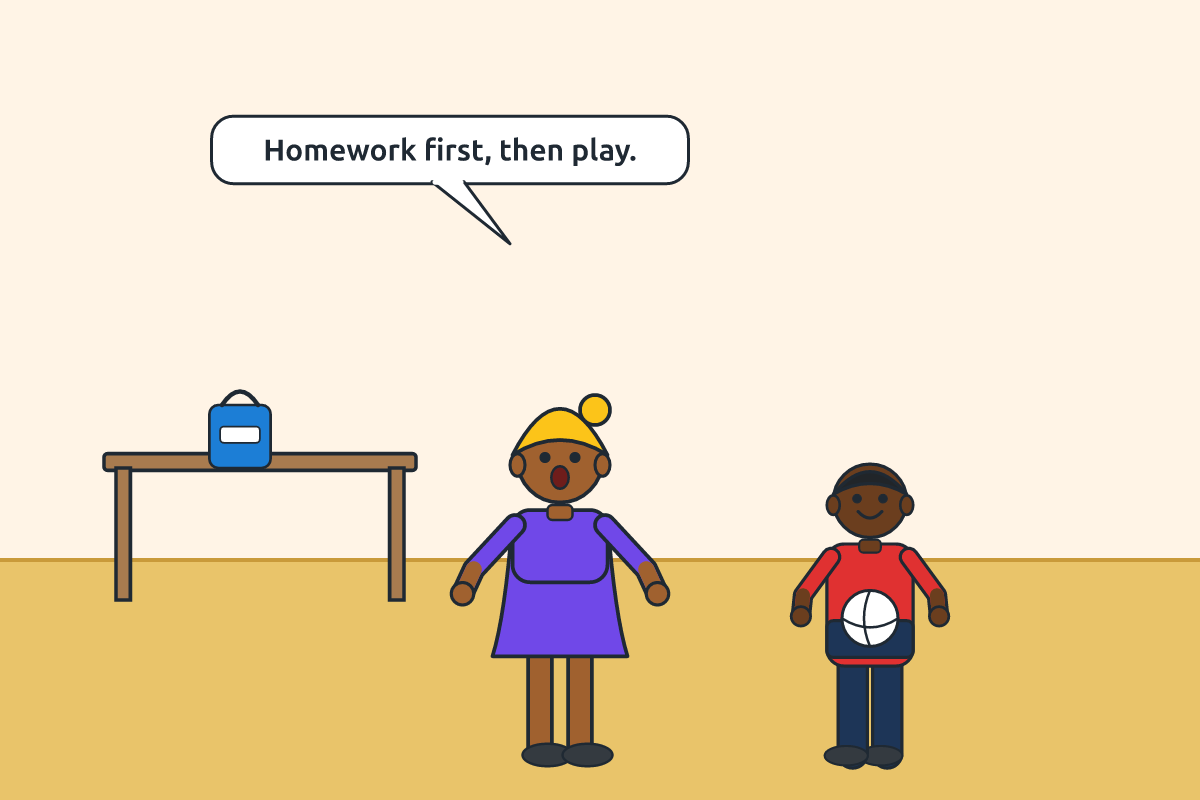
Mother: "Ekow, have you done your homework?"
Ekow: "Not yet, Mother. I was playing."
Mother: "Homework first, then play."
Ekow: "Yes, Mother. I will do it now."
Questions
- What had Ekow not done? (his homework)
- What did Mother say? (Homework first, then play.)
New words
- drama
- A story acted out.
- dialogue
- Words spoken between characters.
- respond
- To answer or react.
Summary
- A drama uses dialogue between characters.
- We listen and answer questions about it.
Exercises
Answer in your exercise book first, then check your answers.
1. What did Ekow forget to do?
- A. His homework
- B. His bath
- C. His prayers
- D. His lunch
Show answer
Answer: His homeworkHe was playing.2. Mother said play comes first.
- A. True
- B. False
Show answer
Answer: FalseShe said homework first.3. Words spoken between characters are ______.
Show answer
Answer: dialogueThat is dialogue.4. What lesson does the drama teach?
Show answer
Answer: Do your work before playing.Homework first, then play.
Lesson 2
- Strand
- Reading
- Sub-strand
- Vocabulary
- Indicator
- B2.2.6.1.1 – Read level-appropriate sight words and use them in meaningful sentences
Introduction
Let us practise more sight words.
Sight Words in Sentences
| around | because | buy | call |
|---|---|---|---|
| cold | does | fast | goes |
"Ama buys bread every morning." "Does the bus go fast?"
New words
- around
- On every side.
- buy
- To get something by paying.
- cold
- Not hot.
Summary
- We use sight words to make sentences.
- Reading sight words quickly helps fluency.
Exercises
Answer in your exercise book first, then check your answers.
1. Which sight word means "to get by paying"?
- A. buy
- B. call
- C. cold
- D. fast
Show answer
Answer: buyBuy means to pay for.2. "Cold" is the opposite of hot.
- A. True
- B. False
Show answer
Answer: TrueThat is its meaning.3. Ama ______ bread every morning. (buys / call)
Show answer
Answer: buysShe pays for bread.4. Write a sentence with "fast".
Show answer
Answer: E.g. The car moves fast.It uses the sight word.
Lesson 3
- Strand
- Writing
- Sub-strand
- Controlled Writing
- Indicator
- B2.4.7.1.1 – Write or copy correct sentences from substitution tables
Introduction
Substitution tables help us build correct sentences.
Substitution Tables
| Who | Does what | When |
|---|---|---|
| Abena | goes to church | on Sunday. |
| Musa | goes to the mosque | on Friday. |
| We | play football | after school. |
New words
- substitution table
- A table for making sentences.
- correct
- Without mistakes.
- column
- A row going down.
Summary
- Pick one item from each column to make a sentence.
- Copy the sentence correctly.
Exercises
Answer in your exercise book first, then check your answers.
1. Which sentence comes from the table?
- A. Musa goes to the mosque on Friday.
- B. Mosque Friday Musa.
- C. Goes Musa.
- D. Friday on.
Show answer
Answer: Musa goes to the mosque on Friday.Correct order.2. "We play football after school." is a correct sentence.
- A. True
- B. False
Show answer
Answer: TrueIt is from the table.3. Abena goes to church on ______.
Show answer
Answer: SundayFrom the table.4. Make one sentence from the table.
Show answer
Answer: E.g. Abena plays football after school.One item per column.
Lesson 4
- Strand
- Writing Conventions & Grammar Usage
- Sub-strand
- Using Simple Prepositions
- Indicator
- B2.5.7.1.1 – Identify prepositions in sentences to indicate days dates and places
Introduction
Prepositions tell us when and where things happen.
Prepositions for Time and Place
| Preposition | Use | Example |
|---|---|---|
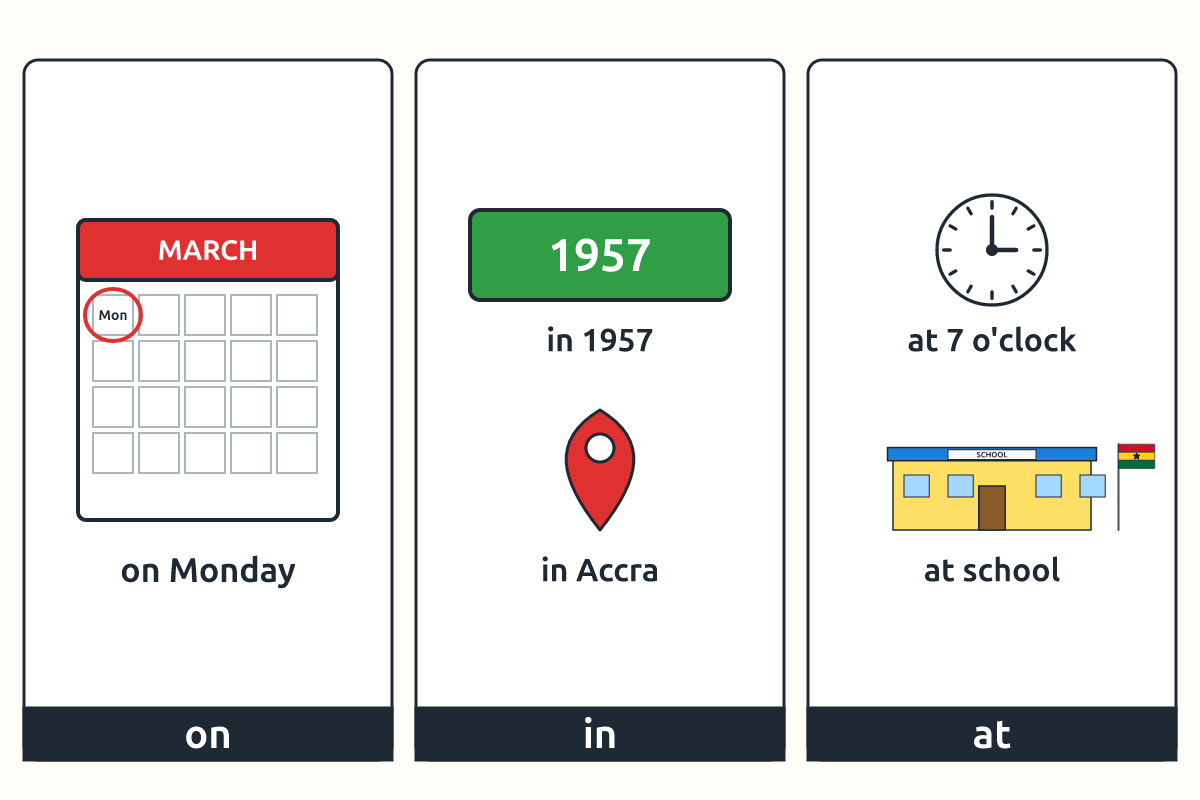
| on | days and dates | on Monday, on 6th March |
| in | months, years, towns | in June, in 1957, in Accra |
| at | times and exact places | at 7 o'clock, at school |
New words
- preposition
- A word that shows time or place.
- date
- The day and month, like 6th March.
- exact
- Precise.
Summary
- Use "on" for days and dates.
- Use "in" for months, years and towns; "at" for times and exact places.
Exercises
Answer in your exercise book first, then check your answers.
1. Ghana became independent ___ 1957.
- A. in
- B. on
- C. at
- D. under
Show answer
Answer: inUse "in" for years.2. "on Monday" is correct.
- A. True
- B. False
Show answer
Answer: TrueUse "on" for days.3. School starts ______ 7 o'clock. (at / in)
Show answer
Answer: atUse "at" for times.4. Write a sentence using "on" with a date.
Show answer
Answer: E.g. My birthday is on 5th May."On" for dates.
Lesson 5
- Strand
- Extensive Reading
- Sub-strand
- Building the Love and Culture of Reading
- Indicator
- B2.6.1.1.1 – Read a variety of age and level appropriate books and texts from print
Introduction
Today we read about Independence Day.
Reading Time
"On 6th March, our school marched at the park. We wore neat uniforms and waved small flags. The District Chief Executive took the salute. We were proud to be Ghanaians."
Questions
- On what date did the school march? (6th March)
- What did they wave? (small flags)
New words
- march
- To walk in step with others.
- salute
- A sign of respect.
- proud
- Pleased about something good.
Summary
- The school marched on Independence Day.
- The pupils were proud to be Ghanaians.
Exercises
Answer in your exercise book first, then check your answers.
1. On what date did they march?
- A. 6th March
- B. 1st July
- C. 25th December
- D. 1st January
Show answer
Answer: 6th MarchGhana's Independence Day.2. They waved small flags.
- A. True
- B. False
Show answer
Answer: TrueThe passage says so.3. We were ______ to be Ghanaians.
Show answer
Answer: proudThe passage says proud.4. What did the pupils wear?
Show answer
Answer: Neat uniformsThe passage tells us.
Homework
- Write three sentences using on, in and at.