Basic 1 · Mathematics · Number Operations
Word Problems: Joining, Separating and Comparing
In this topic you will solve number stories. You will join groups, separate groups and compare groups within 20.
By the end of these notes you should be able to:
- Solve joining (adding) stories within 20
- Solve separating (taking away) stories within 20
- Compare two groups using more, fewer and equal
What you already know
- Adding and subtracting
Copy everything that has a blue line on its left into your notebook. The other parts are for reading.
- Strand
- Number
- Sub-strand
- Number Operations
- Indicator
- B1.1.2.2.1 – Use objects and pictorial models to solve word problems involving joining separating and comparing sets within 20
Introduction
Look at your class. There are 3 girls and 3 boys at the front. The groups are the same size. We say they are equal.
1. Equal Groups
Equal (=) means "the same as".
3 girls = 3 boys because both groups have 3.
2. More and Fewer
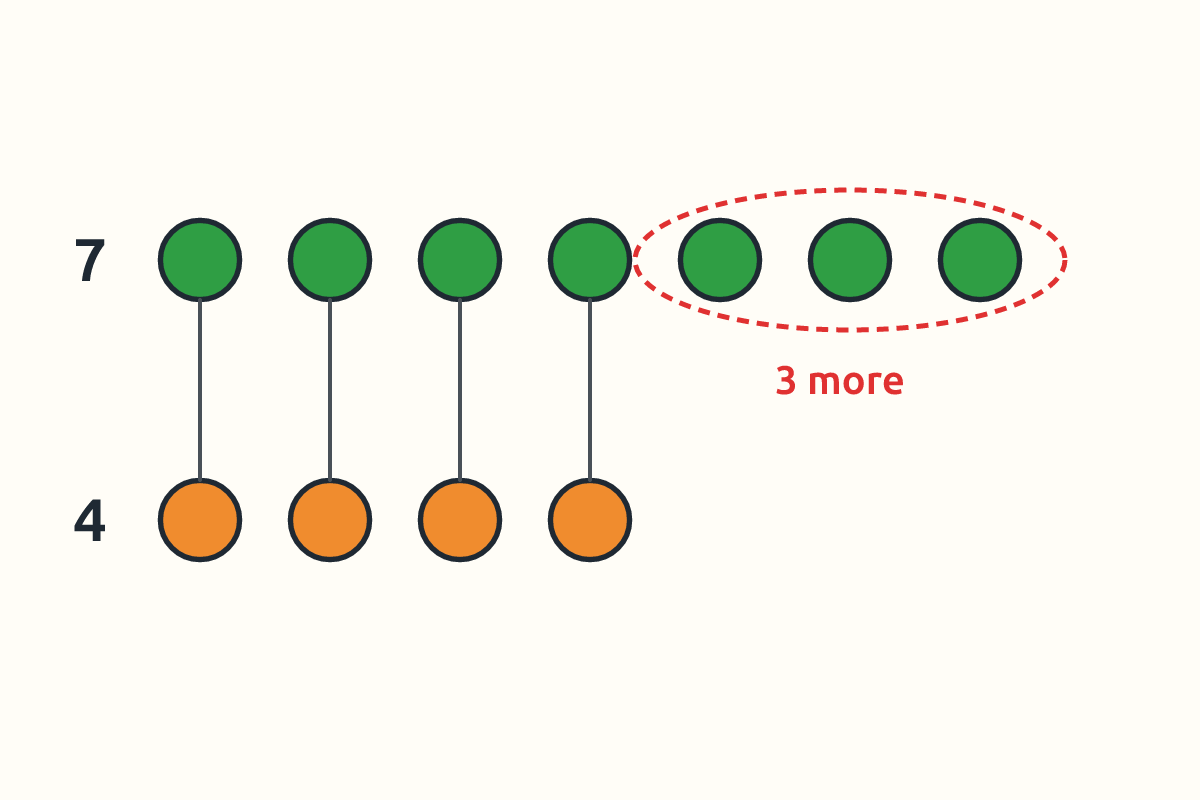
Match the objects one to one. The group with extra objects has more.
Example
Kofi has 7 marbles. Ama has 4 marbles. Who has more? How many more?
- Match 4 of Kofi's marbles with Ama's 4.
- Kofi has 3 marbles left over.
Answer: Kofi has 3 more marbles. 7 – 4 = 3.
3. Joining and Separating Stories
| Story | What to do | Example |
|---|---|---|
| Joining | Add | 9 goats and 6 goats: 9 + 6 = 15 |
| Separating | Subtract | 15 eggs, 5 break: 15 – 5 = 10 |
| Comparing | Subtract | 12 and 8: 12 – 8 = 4 more |
Remember: To find "how many more", take the smaller number from the bigger one.
New words
- equal
- The same number.
- more
- Having a bigger number.
- fewer
- Having a smaller number.
- compare
- To look at two groups to see which is bigger.
Summary
- Equal means the same number.
- Joining stories need adding. Separating stories need taking away.
- To compare, match one to one or subtract.
Class activity: Story Time
- Your teacher tells a number story.
- Use bottle tops to act out the story.
- Write the number sentence.
- Make up your own story for your group to solve.
You need: Bottle tops, Bundles of sticks, Exercise books
Exercises
Answer in your exercise book first, then check your answers.
1. Which group has more: 5 or 9?
- A. 5
- B. 9
- C. They are equal
- D. None
Show answer
Answer: 99 is bigger than 5.2. Esi has 14 beads. She loses 4. How many are left?
- A. 18
- B. 10
- C. 4
- D. 11
Show answer
Answer: 1014 – 4 = 10.3. 6 cups and 6 plates are equal groups.
- A. True
- B. False
Show answer
Answer: TrueBoth groups have 6.4. 8 is fewer than 5.
- A. True
- B. False
Show answer
Answer: False8 is more than 5.5. 10 + 6 = ______
Show answer
Answer: 16Count on 6 from 10.6. Yaw has 12 crayons. Akosua has 9. How many more crayons does Yaw have?
Show answer
Answer: 3 more12 – 9 = 3.
Homework
- Count the boys and girls in your house. Who are more? How many more?