Basic 1 · English Language
Questions, Comprehension, Substitution Tables and Positions
In this topic you will ask and answer yes/no questions, answer questions about a text, copy sentences from a substitution table and use more position words.
By the end of these notes you should be able to:
- Ask and answer yes/no questions
- Answer questions about a short text
- Make sentences from a substitution table
- Use position words correctly
What you already know
- Position words
Copy everything that has a blue line on its left into your notebook. The other parts are for reading.
Lesson 1
- Strand
- Oral Language
- Sub-strand
- Asking and Answering Questions
- Indicator
- B1.1.8.1.1 – Use appropriate pronunciation and intonation in asking and answering yes/no questions
Introduction
Some questions are answered with "yes" or "no".
Yes/No Questions
| Question | Answer |
|---|---|
| Is this your bag? | Yes, it is. |
| Do you like rice? | Yes, I do. |
| Is it raining? | No, it is not. |
| Can you swim? | No, I cannot. |
Our voice goes up at the end of a yes/no question.
New words
- question
- Something we ask.
- answer
- What we say back.
- question mark
- The mark (?) at the end of a question.
Summary
- Yes/no questions are answered with yes or no.
- Questions end with a question mark.
Exercises
Answer in your exercise book first, then check your answers.
1. How do you answer "Do you like rice?"
- A. Yes, I do.
- B. Rice is red.
- C. I am a bag.
- D. Run.
Show answer
Answer: Yes, I do.It answers the question.2. A question ends with a question mark.
- A. True
- B. False
Show answer
Answer: TrueThe mark is ?.3. Is it raining? No, it is ______.
Show answer
Answer: not"No, it is not."4. Write one yes/no question.
Show answer
Answer: E.g. Is the door open?It can be answered yes or no.
Lesson 2
- Strand
- Reading
- Sub-strand
- Comprehension
- Indicator
- B1.2.7.1.2 – Ask and answer factual and inferential and applicative questions about level-appropriate texts
Introduction
Newspapers and adverts have words we can read and understand.
Reading an Advert
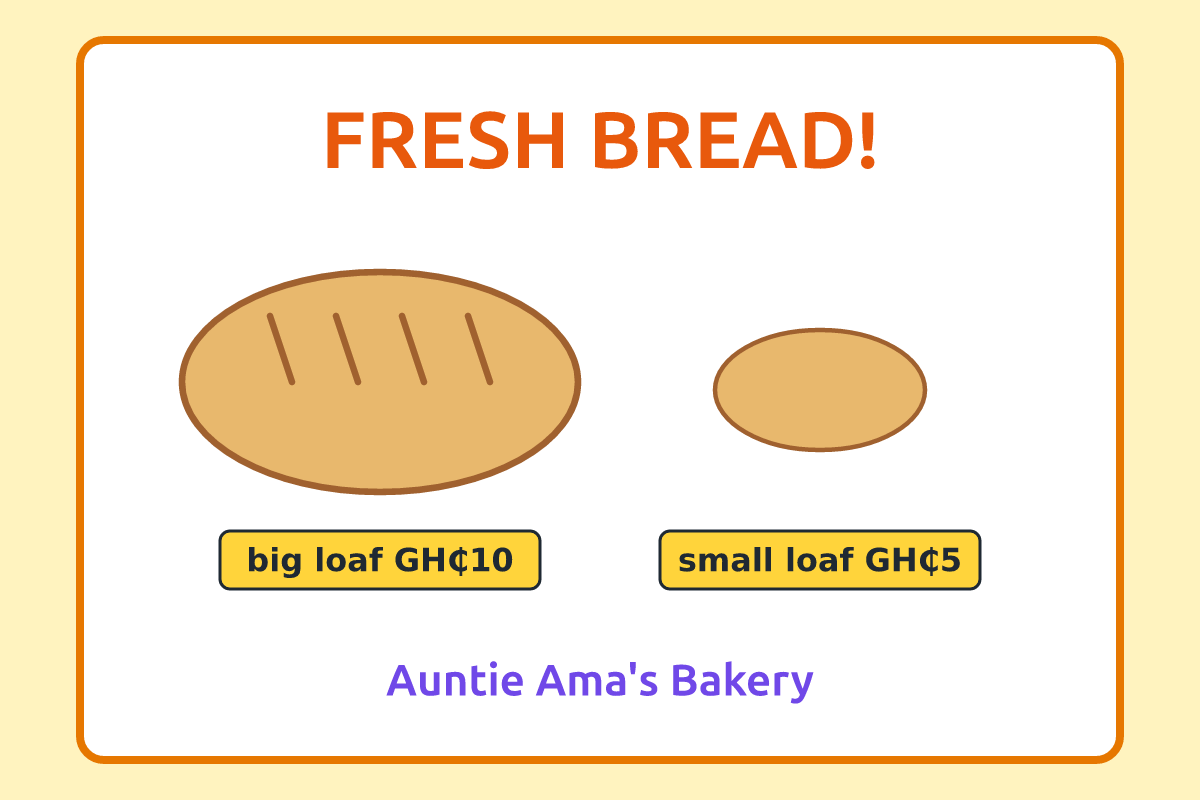
"Fresh Bread! Big loaf: GH₵10. Small loaf: GH₵5. Come to Auntie Ama's Bakery."
Questions
- What is sold? (bread)
- How much is a big loaf? (GH₵10)
- Whose bakery is it? (Auntie Ama's)
New words
- advert
- A notice that tells people to buy something.
- price
- How much something costs.
- bakery
- A place where bread is made.
Summary
- We read adverts and find information.
- A big loaf costs GH₵10.
Exercises
Answer in your exercise book first, then check your answers.
1. How much is a small loaf?
- A. GH₵5
- B. GH₵10
- C. GH₵1
- D. GH₵20
Show answer
Answer: GH₵5The advert says GH₵5.2. The bakery belongs to Auntie Ama.
- A. True
- B. False
Show answer
Answer: TrueThe advert says so.3. A place where bread is made is a ______.
Show answer
Answer: bakeryThat is a bakery.4. What is sold in the advert?
Show answer
Answer: BreadThe advert is about fresh bread.
Lesson 3
- Strand
- Writing
- Sub-strand
- Controlled Writing
- Indicator
- B1.4.7.1.1 – Find read and copy sentences from a given substitution tables
Introduction
A substitution table helps us make many sentences.
Substitution Tables
| Who | Action | What |
|---|---|---|
| Ama | eats | rice. |
| Kofi | drinks | water. |
| The baby | likes | milk. |
Example sentences: "Ama eats rice." "Kofi drinks water." "The baby likes milk."
New words
- substitution table
- A table for making sentences.
- column
- A row going down.
- sentence
- Words that make sense.
Summary
- Choose one word from each column to make a sentence.
- Copy sentences neatly.
Exercises
Answer in your exercise book first, then check your answers.
1. Which sentence can you make from the table?
- A. Kofi drinks water.
- B. Water Kofi drinks.
- C. Drinks Kofi.
- D. Rice baby.
Show answer
Answer: Kofi drinks water.It uses one word from each column in order.2. "The baby likes milk." is a sentence.
- A. True
- B. False
Show answer
Answer: TrueIt makes sense.3. Ama ______ rice.
Show answer
Answer: eatsFrom the table.4. Make one sentence from the table.
Show answer
Answer: E.g. Ama likes milk.One word from each column.
Lesson 4
- Strand
- Writing Conventions & Grammar Usage
- Sub-strand
- Using Simple Prepositions
- Indicator
- B1.5.7.1.1 – Identify and spell simple words correctly
Introduction
Let us use position words to tell where things are.
More Position Words
| Word | Example |
|---|---|
| beside | The calabash is beside the basket. |
| behind | The boy is behind the tree. |
| in front of | The car is in front of the house. |
New words
- beside
- Next to.
- behind
- At the back of.
- in front of
- Ahead of.
Summary
- Beside, behind and in front of are position words.
- They tell where things are.
Exercises
Answer in your exercise book first, then check your answers.
1. The calabash is next to the basket. It is ___ the basket.
- A. beside
- B. under
- C. in
- D. on
Show answer
Answer: besideBeside means next to.2. "Behind" means at the back of.
- A. True
- B. False
Show answer
Answer: TrueThat is its meaning.3. The car is in ______ of the house.
Show answer
Answer: front"In front of".4. Write a sentence with "behind".
Show answer
Answer: E.g. The dog is behind the door.Behind means at the back.
Lesson 5
- Strand
- Extensive Reading
- Sub-strand
- Building the Love and Culture of Reading
- Indicator
- B1.6.1.1.1 – Read a variety of age – appropriate books and texts from print
Introduction
Today we read about a football match.
Reading Time
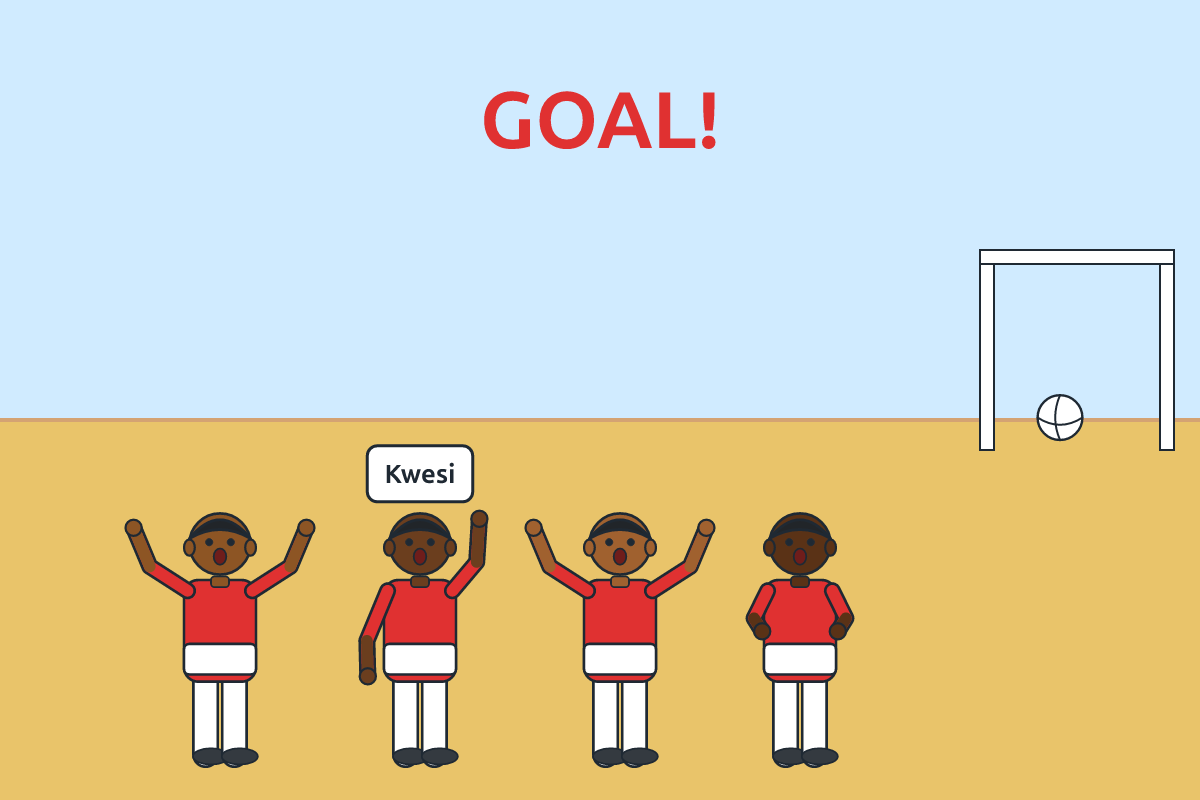
"Our school played football. Kwesi scored a goal. We won the match. Everyone was happy."
Questions
- Who scored a goal? (Kwesi)
- Did the school win? (Yes)
New words
- match
- A game between two teams.
- goal
- A point scored in football.
- won
- Came first in a game.
Summary
- We read about a football match.
- Kwesi scored and the school won.
Exercises
Answer in your exercise book first, then check your answers.
1. Who scored a goal?
- A. Kwesi
- B. Ama
- C. The teacher
- D. Nobody
Show answer
Answer: KwesiThe story says Kwesi.2. The school lost the match.
- A. True
- B. False
Show answer
Answer: FalseThey won.3. Everyone was ______.
Show answer
Answer: happyThe story says happy.4. What game did the school play?
Show answer
Answer: FootballThe story says football.
Homework
- Ask your family three yes/no questions.